Evaluating Ornaments 3D Wave Paper Art for Holiday Decor Projects
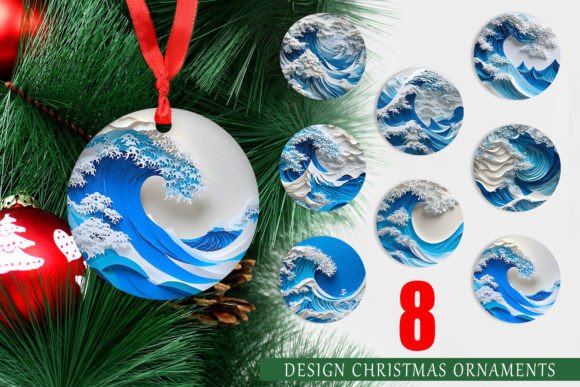
When selecting digital assets for holiday crafting, the distinction between a flat graphic and a design engineered for dimensional assembly is critical. Ornaments 3D Wave Paper Art represents a specific category of printable design that bridges the gap between traditional two-dimensional printing and sculptural paper engineering. Unlike standard clipart intended solely for card fronts or gift tags, these designs utilize optical illusions, shading gradients, and precise geometric layering to create the perception of depth on a flat surface. For crafters aged 20 to 50 who are comparing resources for homemade tree decorations, understanding the technical specifications and practical applications of this art style is essential for achieving professional results without the learning curve of complex 3D modeling software.
Technical Specifications and Print Fidelity
The viability of any printable ornament relies heavily on resolution and color accuracy. When evaluating a set of 8 circular decorative designs, the baseline requirement should be 300 DPI (dots per inch) at the intended print size. A specification of 1500x1500 pixels at 5x5 inches ensures that the intricate lines characteristic of wave art remain crisp rather than pixelated. This resolution is particularly important for 3D wave effects, which depend on fine details to trick the eye into seeing curvature. Lower resolution files may appear acceptable on screen but often result in muddy gradients or jagged edges when printed on cardstock, diminishing the illusion of three-dimensionality.
Furthermore, the PNG format offers distinct advantages over JPEGs for this specific application. PNG files support transparency and lossless compression, preserving the integrity of line work and solid color blocks. When printing on colored paper or layering cutouts, the transparent background eliminates the need for tedious masking or erasing white borders. For users comparing file types, it is worth noting that while SVG files are superior for cutting machines due to their vector nature, high-resolution PNGs provide greater accessibility for those using standard inkjet or laser printers without specialized cutting hardware. The tradeoff is scalability; unlike vectors, these 5x5 inch PNGs have a maximum optimal size, making them perfect for ornaments but less suitable for large-format wall art.
Comparing 3D Wave Art to Traditional Ornament Styles
To make an informed decision, it is helpful to compare Ornaments 3D Wave Paper Art against other prevalent styles in the printable market. Understanding these differences helps determine if this aesthetic aligns with your current project goals or if an alternative would serve you better.
- Flat Vector Illustrations: Standard flat designs are excellent for quick, low-ink projects and modern minimalist aesthetics. However, they lack the visual weight and tactile interest of wave art. If your goal is a decoration that looks substantial from multiple angles on a tree, flat vectors may appear too simple. 3D wave art provides visual complexity that mimics expensive glass or ceramic baubles.
- Watercolor Clipart: Watercolor styles offer organic softness and traditional charm. The tradeoff is precision; watercolor edges can be difficult to cut cleanly by hand, and the colors may shift depending on printer calibration. Wave art typically uses defined boundaries and controlled gradients, making it more forgiving for home printing and hand-cutting.
- Polyfold or Low-Poly Templates: These require scoring, folding, and gluing multiple facets to create actual physical 3D shapes. While structurally impressive, they demand significant time and dexterity. Ornaments 3D Wave Paper Art achieves a similar dimensional effect visually rather than structurally, reducing assembly time from hours to minutes while retaining a sophisticated appearance.
- AI-Generated Imagery: Generative AI can produce unique ornament concepts rapidly. However, AI often struggles with symmetry, consistent resolution, and print-ready formatting. Curated sets of wave art are typically manually refined to ensure circular symmetry and balanced composition, which is crucial for ornaments where asymmetry is immediately noticeable.
Best-Fit Scenarios and Practical Applications
Ornaments 3D Wave Paper Art is not a universal solution for every holiday crafting need. It excels in specific contexts where visual impact and moderate effort are prioritized. This style is ideally suited for adults creating personalized tree decorations who want a handmade feel without the fragility of quilling or the expense of resin casting. The circular format fits naturally within standard ornament templates, wreath centers, and table setting placeholders.
This design approach is also highly effective for mixed-media projects. Because the wave patterns rely on contrast, they respond exceptionally well to metallic papers, pearlescent cardstock, or selective gloss varnishing. Adding a spot UV coat or glitter gel pen to the "high points" of the wave pattern can enhance the 3D illusion physically. For educators or parents leading group crafts, this style offers a high success rate; the pre-rendered shading means participants do not need advanced drawing skills to achieve a polished look. Conversely, if you are looking for designs to be used as iron-on transfers for fabric or window clings, this style may be less appropriate due to its reliance on subtle tonal shifts that do not translate well to vinyl or heat-transfer materials.
Material Selection and Printing Considerations
The choice of substrate significantly influences the final outcome of 3D wave paper art. While standard copy paper can technically accept the ink, it lacks the rigidity required for hanging ornaments. Evaluating paper weight is a necessary step in the planning process.
- Cardstock Weight: For 5x5 inch ornaments, 65lb to 80lb (176–216 gsm) cardstock is generally the sweet spot. Lighter weights may curl under the ink load, distorting the wave image, while heavier weights can be difficult to cut precisely along curved lines.
- Paper Finish: Matte or satin finishes are preferable to high-gloss photo paper for this art style. Glossy surfaces reflect ambient light, which can interfere with the printed shadows and highlights that create the 3D effect. Matte paper absorbs light, allowing the printed dimensionality to remain the primary visual focus.
- Ink Type: Dye-based inks tend to produce more vibrant gradients essential for wave art, whereas pigment inks sit on top of the paper and can sometimes appear chalky on uncoated stock. However, pigment inks offer better archival stability. Users must weigh immediate visual pop against long-term colorfastness based on whether the ornaments are intended for single-season use or heirloom preservation.
Limitations and Decision Factors
Despite its strengths, Ornaments 3D Wave Paper Art has inherent limitations that buyers should acknowledge. As raster-based PNGs, these files cannot be resized infinitely without quality loss. If you require ornaments larger than 5 inches or smaller than 2 inches, you may need to source vector alternatives or accept some degradation in edge sharpness. Additionally, because the 3D effect is simulated through color, the design is static. It does not change appearance based on viewing angle in the same way a true hologram or lenticular print would.
Another consideration is color management. Screen-to-print variance is common, especially with the deep blues, purples, and golds often used in wave art. Users without calibrated monitors or custom ICC profiles for their printers may need to perform test prints to adjust saturation and brightness. This adds a preliminary step that simpler, flat-color designs do not require. Finally, while the set of 8 provides variety, it is a fixed collection. Those seeking extensive customization or thematic coherence across dozens of ornaments might find a limited set restrictive compared to subscription-based libraries or generative tools.
Making the Final Selection
Choosing the right digital asset involves balancing aesthetic preference with technical reality. Ornaments 3D Wave Paper Art offers a compelling middle ground for adult crafters seeking sophistication without excessive labor. It outperforms flat clipart in visual interest and surpasses complex papercraft templates in accessibility. By verifying the 300 DPI resolution, selecting appropriate matte cardstock, and understanding the distinction between simulated and structural depth, users can leverage these PNG files to create distinctive holiday decor.
Ultimately, the decision should hinge on your specific workflow. If you value speed, visual texture, and compatibility with standard home printers, this format is likely the correct choice. If you require infinite scalability, fabric compatibility, or structural engineering, exploring vector packs or foldable templates would be a more prudent investment. Evaluating these factors objectively ensures that the selected resource supports both the creative vision and the practical constraints of your holiday decorating project.